Microscopy VS PCR
⌂ > Microscopy VS PCR
With PCR, analyses are usually centralized and must be shipped to specialized labs, which often leads to delays of several days before results are available. This makes it difficult to intervene on time. In contrast, microscopy is a portable method that can be performed near the sampling site, enabling much faster reaction times and maximizing the chances of protecting crops before it is too late.
When comparing quantitative PCR results with microscopy counts for the same sample, PCR often appears more sensitive because genome counts per liter of air are typically higher or equal to spore counts. However, this difference arises because several fungal pathogens, such as Alternaria and Phytophthora, contain multiple genomes per spore. For example, 10 genomes detected by PCR or one spore observed under the microscope are equivalent and correspond to capturing a single spore.
Ultimately, the sensitivity of both methods depends more on the air sampling strategy and timing than on the analysis method itself.
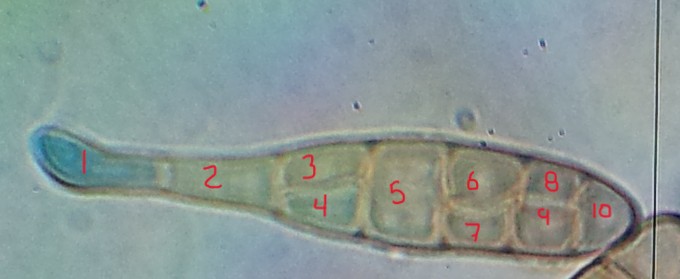
Both PCR and microscopy require solid validation processes to ensure optimal sensitivity. For microscopy, this involves studying spore varieties that are morphologically similar to the target spores and identifying discriminating traits for reliable identification. Slide preparation is non-destructive and does not hinder spore detection.
For PCR, validation is equally crucial, but since the method involves multiple sequential steps, an error at any stage can drastically affect the results. Another advantage of microscopy is that each slide can be reanalyzed immediately by anyone, using the original sample. In contrast, qPCR requires a complete new sample preparation for reanalysis.
Unlike PCR, which targets specific species using primers, microscopy allows for the observation of all spores present in the sample, including non-targeted or emerging pathogens. This broader perspective provides valuable insights into the phytosanitary risks of a field or region.
PCR remains a valuable method for specific confirmations or targeted research where precise genetic identification is required. However, for routine surveillance, microscopy stands out due to its speed and reliability. It enables early and comprehensive detection of airborne pathogens, making it an ideal tool for daily monitoring of fungal diseases in agriculture.